

A "normal" cholesterol result is good news, but it may not be the whole story. About half of the people who had a heart attack had cholesterol in the normal range. A test that counts the particles carrying your cholesterol, and sorts them by size, can show risk that a standard laboratory lipid panel can miss.
What a standard cholesterol test leaves out
A standard lipid panel measures how much cholesterol is in your blood: total cholesterol, LDL ("bad"), HDL ("good") and triglycerides. These numbers matter, and lowering LDL cholesterol is still the main treatment target. What the panel does not show is how many particles carry that cholesterol, or how big they are.
Cholesterol is a fat, so your body packs it into tiny carriers called lipoproteins. Think of cholesterol as passengers and lipoproteins as cars. A standard test counts the passengers. An LPP test counts the cars and checks what kind they are.
This matters because plaque starts when these particles push into an artery wall. More particles means more chances for that to happen, even when total cholesterol looks fine.
Why small, dense LDL matters
LDL particles come in different sizes. Small, dense LDL slips into artery walls more easily and is more easily damaged by oxidation. Two people can share the same LDL cholesterol number, yet the one with more small particles can carry much higher risk.
SpectraCell's clinical literature estimates that over 30% of people have high small, dense LDL, often with cholesterol that looks normal. This is especially common when triglycerides are high or HDL is low.
When to ask about advanced testing
Ask your provider about advanced lipid testing if:
- Your cholesterol is normal, but heart disease runs in your family
- Your triglycerides are high or your HDL is low
- You have insulin resistance, diabetes, or extra weight around your waist
- You take a cholesterol medication and want to see how your particles respond
What the LPP test measures
SpectraCell's Lipoprotein Particle Profile (LPP) measures the number, size and density of your lipoproteins, plus a standard cholesterol panel.
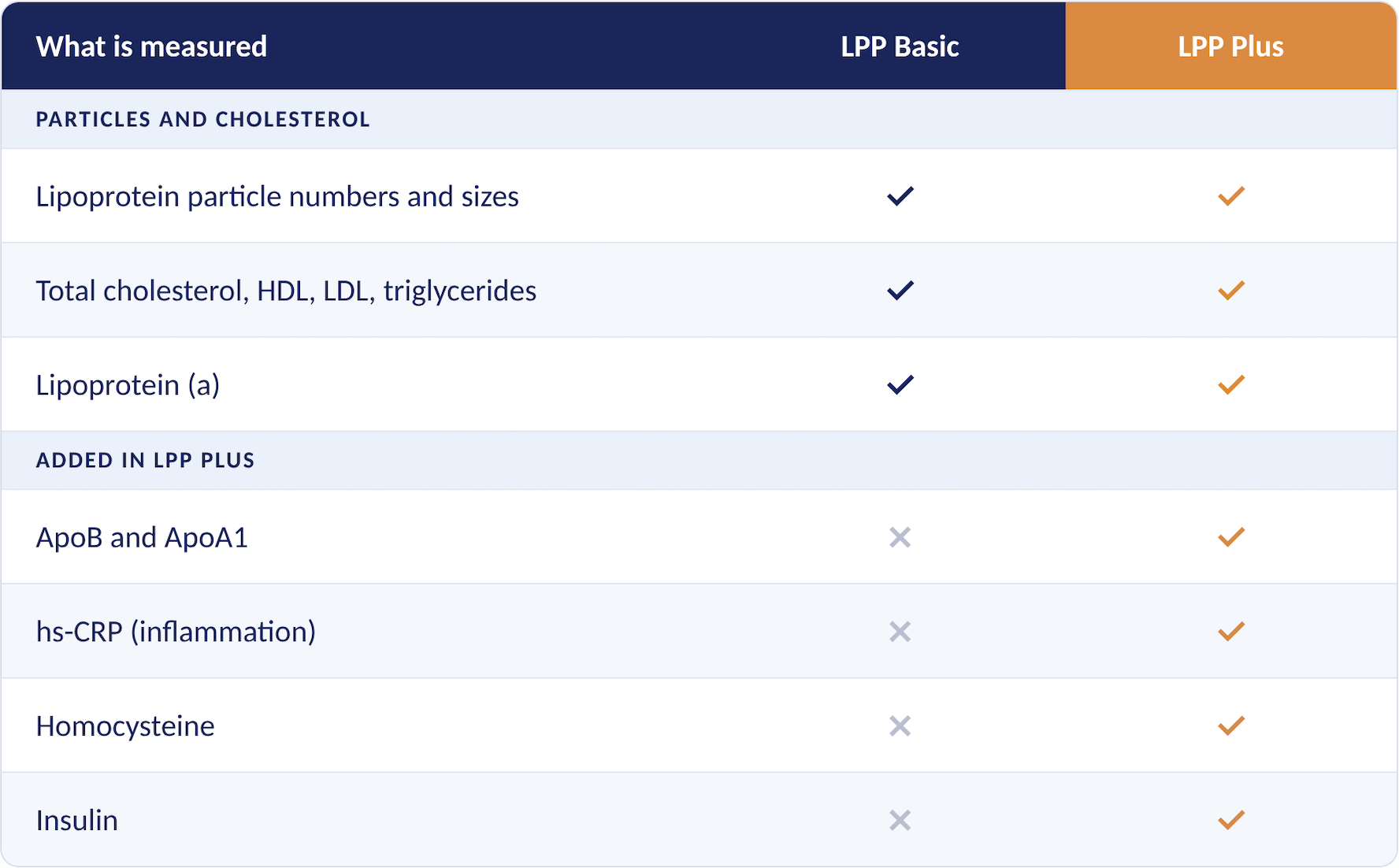
Key results in plain words:
- LDL particle number: how many LDL "cars" are on the road
- Small, dense LDL (LDL III and IV): the particles that enter artery walls most easily
- HDL2b: protective HDL that carries extra fat back to the liver
- Remnant lipoprotein (RLP): leftover particles that can build plaque without being damaged first
- Lp(a): a particle mostly set by your genes that can promote clotting and plaque
- ApoB: found once on every plaque forming particle, so it reflects their total count
The lab spins your sample at 120,000 rpm to separate particles by density, then counts each group with a fluorescent dye. This method, analytical ultracentrifugation, is considered by the CDC the gold standard for sorting lipoproteins. Many other particle tests use NMR, which estimates particle numbers without physically separating them.
What to do with your results
- Review them with your provider. The best plan depends on which particles are out of range.
- Never stop or change a prescribed cholesterol medication on your own.
- Support healthy particles: fewer refined carbs, sugary drinks and trans fats, more vegetables, and daily movement.
- Ask whether nutrient testing makes sense. SpectraCell's Micronutrient Test shows which vitamins and minerals your cells are low in.
- Plan a retest with your provider to see what changed.
How to get tested
You can get the LPP Plus through your healthcare provider, or order LPP Plus online and visit a nearby draw site. Fast for 9 to 12 hours before your draw. Results are emailed to you securely, within 14 days, so you can share them with your provider.
For practitioners
The LPP gives subgroup level data to guide treatment before overt dyslipidemia appears on a standard panel.
- Direct subgroup measurement: VLDL; RLP (VLDL3 plus IDL); LDL I to IV; HDL2b, HDL2a and HDL3, reported in nmol/L
- NCEP emerging risk factors: small, dense LDL, RLP, Lp(a) and HDL2b
- Methodology: analytical ultracentrifugation at 120,000 rpm (about 600,000 g) with a continuous density gradient, then direct particle counting by fluorescent dye; NMR profiles are estimated by signal deconvolution without separation
- Treatment by subgroup: each subgroup is reported, so interventions can target the particle that is elevated
- Specimen and panels: serum, 2 SST, fasting 9 to 12 hours. Available as LPP Basic, LPP Plus, CardiacNexus (with MTHFR), Cardi-A1c and Baseline Nexus


